Adulthood
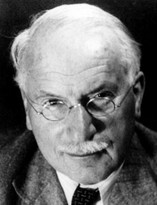 (Jung, 2013) (Jung, 2013)
"Jung traveled throughout the world to teach and influence others with his psychoanalytical theories. He published many books relating to psychology, and others that seemed outside the realm science, including Flying Saucers: A Modern Myth of Things Seen in the Skies, which examined and dissected the psychological significance of UFO sightings. Jung’s work embodied his belief that each person has a life purpose that is based in a spiritual self. Through his eastern, western, and mythological studies, Jung developed a theory of transformation called individuation that he explored in Psychology and Alchemy, a book in which he detailed the relationship of alchemies in the psychoanalytical process." ―goodtherapy.org
|
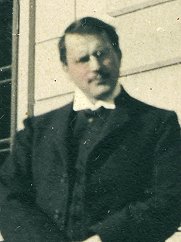 (Jung in his earlier adulthood, 2010) (Jung in his earlier adulthood, 2010)
"As Jung grew older, his keen interest in a large variety of sciences, and the history of religion made the choice of a career quite difficult. However, he finally decided on medicine, which he studied at the University of Basel (1895-1900). He received his medical degree from the University of Zurich in 1902. Later he studied psychology (the scientific study of the mind and its processes) in Paris, France." ―notablebiographies.com |
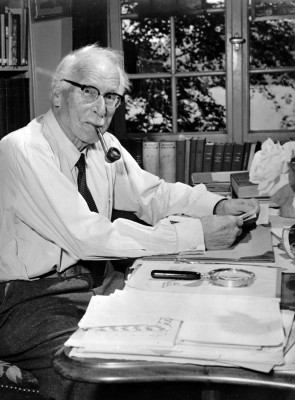 (Carl Jung, 2013)
"Jung decided to study medicine, but also developed an interest in spiritual phenomena while in school. It was this fascination with medicine and spirituality that led him into the field of psychiatry, which he viewed as a combination of his two interests. In 1902, he completed his doctoral dissertation, titled "On the Psychology and Pathology of So-Called Occult Phenomena" and graduated from University of Basel with a medical degree."
―Psychology.about.com
During his journey through medical school, he switched interests to spirituality, which was the beginning of his psychological path.
"Of prime importance to Jung was the detailing of the stages of inner development and of the growth of the personality, which he termed the 'process of individuation.' He described a strong impulse from the unconscious to guide the individual toward its most complete uniqueness. This achievement is a lifelong task of trial and error and identifying and uniting contents of the unconscious. It consists in an ever-increasing self-knowledge and in 'becoming what you are.'"
―Encyclopedia of World Biography
―Psychology.about.com
During his journey through medical school, he switched interests to spirituality, which was the beginning of his psychological path.
"Of prime importance to Jung was the detailing of the stages of inner development and of the growth of the personality, which he termed the 'process of individuation.' He described a strong impulse from the unconscious to guide the individual toward its most complete uniqueness. This achievement is a lifelong task of trial and error and identifying and uniting contents of the unconscious. It consists in an ever-increasing self-knowledge and in 'becoming what you are.'"
―Encyclopedia of World Biography
Love Life
"Where love rules, there is no will to power; and where power predominates, there love is lacking. The one is the shadow of the other." ―Carl Jung Jung met Emma Rauschenbach when she was 16, and he was 21.She came from an old Swiss/ German family that were mainly wealthy industrial workers. The wealth from her family gave Jung the chance to pursue his interest dreams with financial freedom. They married on February 14, 1903, seven years after they first met. Emma was quite interested in her husband's work, and became a psychologist as well. From 1904 to 1914, they had 5 children, one boy and four girls. On November 27, 1955, Emma Jung died at the age 73. As Carl mourned for her, he states, "She was the foundation of my house," and that "She was Queen!" |
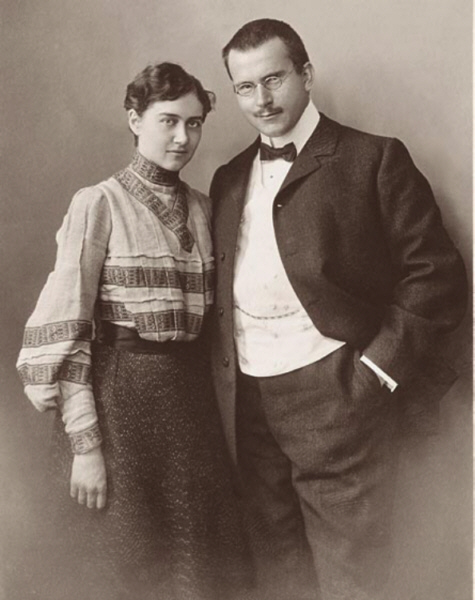
(Jung and his wife, Emma, 2011)
|
"A particularly beautiful woman is a source of terror. As a rule, a beautiful woman is a terrible disappointment."
―Carl Jung
Family
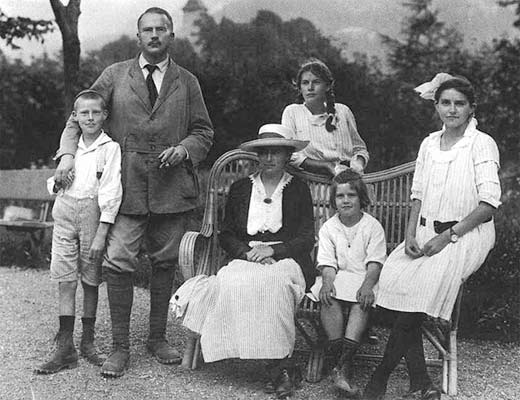 (Carl Jung and family, 1917)
"In 1903 Jung married Emma Rauschenbach. She was his loyal companion and scientific coworker until her death in 1955. The couple had five children, and lived in Küsnacht on the Lake of Zurich." ―notablebiographies.com
Jung's five children
Jung's five children
- Agathe Niehus: firstborn daughter, born on December 28,1904
- Gret Baumann: second-born daughter, on February 8, 1906
- Franz Jung-Merker: third child and only son, born November 28, 1908
- Marianne Niehus: fourth daughter born on September 20, 1910
- Helene Hoerni: last born child/daughter, on March 18, 1914

*Signature of Carl Jung, no date applicable